
Choosing the right LMS in Dubai is a business decision, not just a software comparison
Focus on multilingual support, compliance (KHDA, DHA, DFSA), and scalability
Prioritize usability and mobile-first experience — adoption matters more than features
Evaluate content creation speed, integrations, and analytics that connect learning to outcomes
Compare platforms based on real use cases, not demo features
Avoid common mistakes like feature-based or price-based selection
Use a structured approach like the D.U.B.A.I framework
Bottom line: The best LMS is the one your employees use and that delivers measurable business impact.
This guide helps you evaluate the top LMS platforms in Dubai with a focus on real business outcomes and training effectiveness.
If you want a broader understanding of training strategies in the region, read our Corporate Training guide for L&D leaders.
What is a Learning Management System?
A Learning Management System (LMS) is a digital platform that helps organizations create, deliver, track, and manage employee training in a centralized and scalable way. It supports different learning formats such as courses, assessments, and certifications, making it easier to train employees across locations.
In Dubai, LMS platforms are especially critical due to strict compliance requirements and a highly diverse, multilingual workforce, making structured and accessible training essential for business success.
Choosing the Best LMS in Dubai: Market Reality and Key Challenges (2026)
As L&D leaders and HR managers in Dubai navigate workforce training in 2026, one question remains critical: how do you select an LMS that delivers measurable results in a fast-paced, multicultural environment?
The stakes are high. Choosing the wrong platform leads to poor adoption, budget overruns, and compliance risks, while the right LMS improves time-to-competency, ensures regulatory readiness, and drives business performance.
UAE’s workforce is one of the most diverse in the world, with more than 200 nationalities across industries — a reality that is especially visible in Dubai, the country’s primary business hub.
At the same time, the UAE corporate e-learning market was valued at approximately USD 1.51 billion in 2024 and is projected to reach nearly USD 4.88 billion by 2030, growing at a CAGR of about 21.8%. As the UAE’s leading commercial center, Dubai is a key driver and direct beneficiary of this growth, with organizations rapidly adopting digital learning solutions.
However, traditional LMS platforms struggle to meet these evolving needs:
Limited multilingual support
Poor mobile experience
Complex content creation
Low engagement
Limited ability to measure ROI
As a result, L&D leaders are under pressure to reduce time-to-competency, maintain compliance with authorities such as KHDA, ACTVET, DHA, and DFSA, and deliver measurable outcomes.
To meet these demands, organizations are moving away from legacy systems toward intelligent, future-ready platforms.
This shift is essential for building agile, compliant, and high-performing workforces ready for the future of work.
Best LMS Platforms in Dubai for 2026 (Compared & Reviewed)

Before comparing LMS platforms, it’s important to be clear on what your organization actually needs. Focus on practical factors like ease of use, scalability, integration with existing systems, and how well the platform supports your business goals.
With that clarity in place, here are some of the top LMS platforms used by organizations in Dubai, selected based on their ability to support corporate training, compliance requirements, and long-term growth.
1. Calibr
Calibr is an AI-powered LMS + LXP platform designed for modern corporate training needs in the UAE. It combines compliance management, personalized learning, and real-time analytics in a single system.
Key capabilities:
AI-powered course creation for faster content development
Personalized learning paths based on role and performance
Multilingual support including Arabic (RTL)
Mobile-first learning with offline access
Automated compliance tracking and reporting
Best For
Suitable for organizations that need a unified platform to manage compliance, employee development, and workforce training at scale.
It is typically a good fit for mid-sized to large organizations looking for a system that supports long-term growth and evolving learning needs.
Considerations:
Platform ecosystem is still evolving compared to long-established vendors
May require evaluation for highly specialized enterprise use cases
Key Takeaway
A suitable option for mid-sized to large organizations seeking AI-assisted course creation, personalized learning, and centralized compliance management in one platform.
2. Adobe Learning Manager
Adobe Learning Manager is an enterprise LMS used by organizations that require structured training delivery and centralized management.
Key capabilities:
Reporting dashboards to track learner activity and completion
Integration options with enterprise systems
Support for structured learning programs and certifications
Best For
Organizations with defined L&D processes
Larger teams managing structured training programs.
Considerations:
Implementation may require more setup and coordination
Cost structure may be higher compared to some mid-market tools
Content updates may depend on internal expertise or external support
Key Takeaway
Best suited to organizations with established L&D processes that need structured learning delivery, centralized management, and enterprise integrations.
3. TalentLMS
A cloud-based LMS designed to simplify training delivery for businesses of all sizes, with a focus on ease of use and quick setup.
Key Capabilities
Course creation with built-in authoring tools
Gamification (badges, points, leaderboards)
Compliance training management
Mobile learning support
Integrations with HR and business tools
Best For
Small to mid-sized businesses
Companies looking for quick deployment
Teams prioritizing ease of use
Considerations
Limited advanced customization compared to enterprise platforms
May not support highly complex training workflows
Key Takeaway
A practical choice for small to mid-sized businesses prioritizing ease of use, quick implementation, and straightforward employee training.
4. Cornerstone OnDemand
An enterprise-grade talent and learning platform that integrates learning with performance and talent management.
Key Capabilities
End-to-end talent and learning suite
Analytics and reporting features
Compliance and certification tracking
Global workforce support
Best For
Large enterprises
Organizations needing integrated HR + learning systems
Companies with complex compliance requirements
Considerations
Higher implementation effort
Can be complex for smaller teams
Key Takeaway
Ideal for large enterprises that want to connect learning with talent management, performance development, and complex compliance requirements.
5. Docebo
An AI-powered LMS that focuses on automation, personalization, and scalable learning experiences.
Key Capabilities
AI-driven content recommendations
Learning automation workflows
Social and informal learning features
Extended enterprise training (partners/customers)
Strong integrations ecosystem
Best For
Growing and enterprise organizations
Companies focusing on personalized learning
Businesses training external audiences
Considerations
Pricing may be higher than basic LMS platforms
Requires configuration for advanced features
Key Takeaway
A strong option for growing and enterprise organizations seeking AI-driven personalization, automated learning workflows, and training for employees and external audiences.
6. SAP SuccessFactors Learning
A learning management system within the SAP SuccessFactors suite, designed for enterprise workforce training and compliance.
Key Capabilities
Deep integration with SAP HR systems
Compliance and certification management
Global training deployment
Advanced reporting and analytics
Workforce development tools
Best For
Large enterprises using SAP ecosystem
Organizations with strict compliance needs
Global companies managing large workforces
Considerations
Complex implementation and setup
Less flexibility outside SAP ecosystem
Key Takeaway
Best for large organizations already using SAP SuccessFactors that need integrated workforce training, compliance tracking, and global learning management.
While each platform offers different strengths, the right LMS for your organization in Dubai depends on how well the platform aligns with your workforce structure, compliance requirements, and growth plans.
Quick Comparison: Compare the Features of Top LMS Platforms in Dubai (2026)
Feature / Platform | Calibr | Adobe Learning Manager | TalentLMS | Cornerstone OnDemand | Docebo | SAP SuccessFactors Learning |
|---|---|---|---|---|---|---|
AI Content Creation | Advanced | Limited | Limited | Moderate | Advanced | Limited |
Personalization | Advanced | Rule-based | Basic | Advanced | AI-driven | Advanced |
Multilingual (Arabic) | Strong | Available | Available | Strong | Strong | Strong |
Mobile Learning | Yes | Yes | Yes | Yes | Yes | Yes |
Compliance | Strong | Strong | Moderate | Strong | Strong | Strong |
Ease of Use | Very easy | Moderate | Easy | Complex | Moderate | Complex |
Integrations | Strong | Strong | Strong | Strong | Strong | Strong |
Scalability | High | High | Moderate | Very High | High | Very High |
Best Fit | Corporate training | Enterprise learning | SMBs | Enterprise talent mgmt | AI-driven learning | SAP ecosystem |
Limitations | Newer platform | Complex setup | Limited enterprise depth | Complex implementation | Needs configuration | Heavy SAP dependency |
While all platforms offer core LMS capabilities, the key difference lies in how effectively they support multilingual workforces, compliance requirements, and scalable learning in Dubai-based organizations
Quick Recommendation: Which LMS Should You Choose?
Choose Calibr → if you need AI-powered course creation, compliance tracking, and scalable training
Choose Adobe Learning Manager → if you are a large enterprise with structured learning programs
Choose TalentLMS → if you want an easy-to-use LMS for quick deployment and small to mid-sized teams
Choose Docebo → if you want AI-driven learning and automation at enterprise scale
Choose Cornerstone OnDemand → if you need a complete talent + learning management solution
Choose SAP SuccessFactors Learning → if you are already using SAP systems and need deep HR integration
The LMS Selection Risk Map: 5 Mistakes That Cost Organizations in Dubai
LMS selection mistakes can lead to low employee adoption, delayed implementation, compliance gaps, and unexpected costs. The table below highlights five common risks, their business impact, and how organizations can avoid them.
Common Mistake | What Happens | Business Impact | How to Avoid It |
|---|---|---|---|
The Feature Trap | Choosing a platform based on feature-heavy demos rather than everyday usability. | Low adoption, employee frustration, and underused features. | Prioritize ease of use and test the platform with actual employees before selecting it. |
The Desktop-Only Assumption | Overlooking mobile access for frontline and field-based employees. | Lower course completion and limited training accessibility. | Choose a mobile-friendly LMS with cross-device access and offline learning where required. |
The Content Bottleneck | Underestimating the time needed to create, update, and manage training materials. | Delayed rollout, outdated content, and reduced engagement. | Look for built-in authoring tools, reusable templates, and AI-assisted content creation. |
The Localization Gap | Ignoring Arabic language support, cultural context, and applicable UAE compliance requirements. | Lower engagement, accessibility issues, and potential compliance risks. | Verify Arabic and right-to-left language support, and review relevant local training requirements. |
The Cost Illusion | Comparing platforms based only on upfront subscription prices. | Unexpected expenses, scaling difficulties, and costly platform changes. | Compare total cost of ownership, including implementation, integrations, support, and future expansion. |
Key takeaway: Successful LMS selection requires more than comparing features and prices. Evaluate usability, mobile accessibility, content management, localization, and long-term costs before making a decision.
The D.U.B.A.I LMS Selection Framework for L&D Leaders
An LMS decision in Dubai cannot be made on features alone—it must be evaluated against real business needs, workforce realities, and expected outcomes. The D.U.B.A.I framework provides a structured way to assess and implement the most suitable solution effectively.
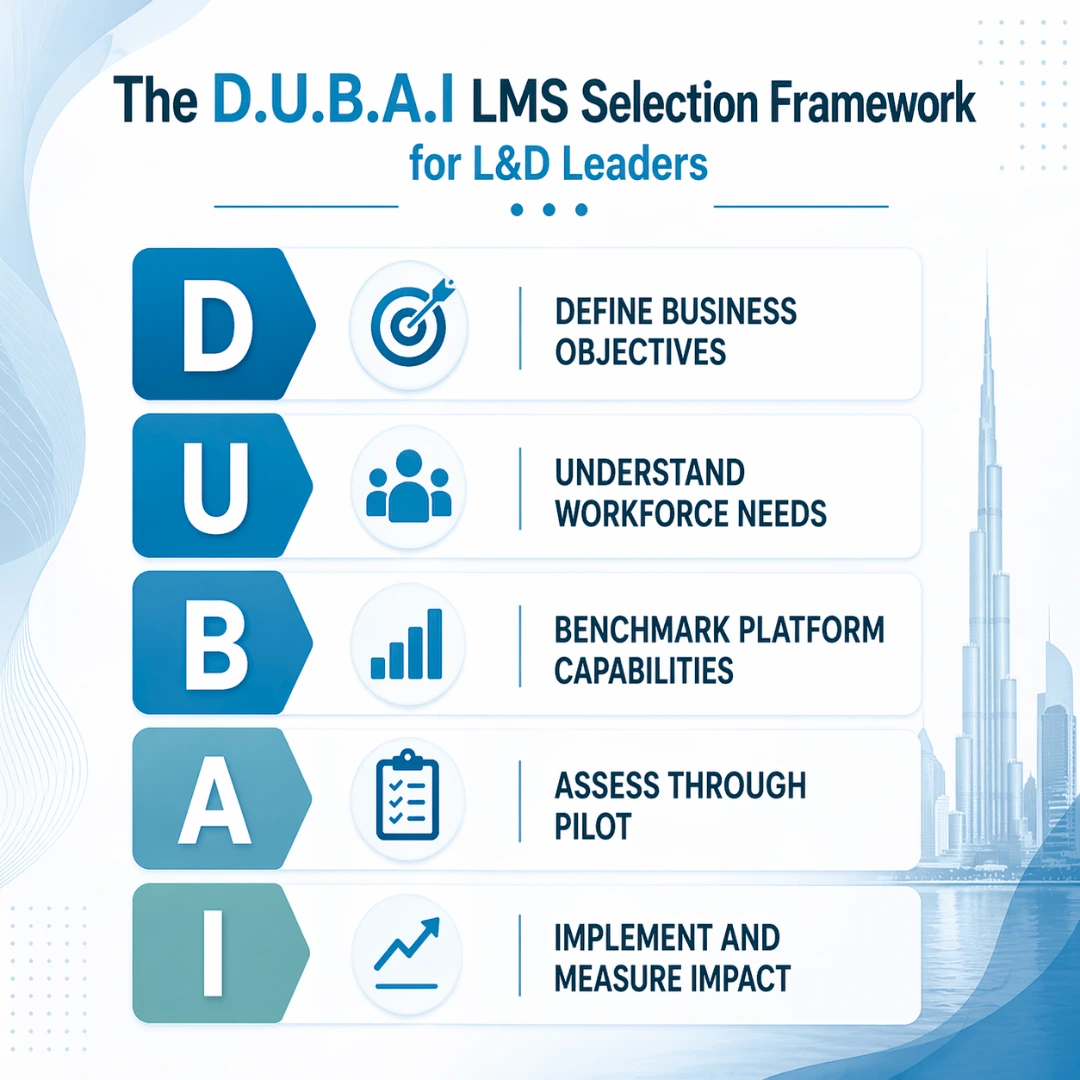
D — Define Business Objectives
Start by clearly identifying the business outcomes you want to achieve through your LMS.
Are you aiming to improve onboarding speed or reduce time-to-competency?
Do you need to strengthen compliance and regulatory readiness?
Are you focused on improving employee performance or customer experience?
A clear understanding of business objectives ensures that your LMS investment delivers measurable value.
U — Understand Workforce Needs
Your LMS must align with how your workforce operates in reality.
What are the different learner personas (desk-based vs. frontline employees)?
What are their language preferences and digital comfort levels?
What type of content is required (compliance, technical training, soft skills)?
In Dubai’s multicultural environment, understanding workforce diversity is critical for adoption and effectiveness.
B — Benchmark Platform Capabilities
Evaluate LMS platforms based on practical, business-relevant criteria rather than feature lists.
User Experience: Is the platform intuitive for all employees?
Content Creation: Can teams build and update content quickly?
AI & Automation: Does it offer real value or just marketing claims?
Analytics: Can it track outcomes that matter to leadership?
Scalability: Will it support future growth?
The goal is to select a platform that performs well in real-world conditions.
A — Assess Through Pilot
Before full implementation, validate your LMS through a controlled pilot.
Test with diverse user groups across roles and locations
Define clear success metrics (engagement, completion, usability)
Gather feedback and identify gaps
A pilot helps reduce risk and ensures the platform meets actual business needs.
I — Implement and Measure Impact
Implementation is not complete until learning impact is measurable.
Track metrics such as:
Time-to-competency (how quickly employees reach required skill levels)
Course completion rates
Assessment scores and retention levels
Reduction in compliance violations
Training ROI (cost vs performance improvement)
In Dubai’s compliance-driven industries, tracking these metrics is essential for audit readiness,
Final Thoughts: Choosing the Best LMS in Dubai (2026)
Choosing the best LMS in Dubai in 2026 is no longer just a technology decision — it’s a strategic investment in workforce capability and long-term business performance.
Among modern platforms designed for these needs, some solutions stand out based on their ability to combine compliance, development, and usability in one system.
Platforms like Calibr delivers everything modern organizations need: AI-powered personalization, rapid content creation, mobile-first learning, real-time analytics, multilingual support, and proven results across healthcare, hospitality, manufacturing, BFSI, and retail.
Ready to transform Your Corporate Training today?
Frequently Asked Questions (FAQ's)
What is the best LMS in Dubai for corporate training?
The best LMS in Dubai depends on company size and use case:
AI-driven and scalable training → Calibr
Enterprise learning ecosystems → Cornerstone OnDemand or SAP SuccessFactors Learning
Quick deployment for smaller teams → TalentLMS
For most mid-sized organizations in Dubai, platforms that support compliance, multilingual training, and fast deployment are preferred.
Does an LMS in Dubai need to support Arabic?
Yes. While many organizations operate in English, Arabic language support (including RTL) is important for compliance, inclusivity, and workforce adoption—especially in government, healthcare, and large enterprises.
What compliance authorities govern corporate training in Dubai?
Key authorities include:
KHDA (Knowledge and Human Development Authority) – regulates education and training providers
ACTVET (Abu Dhabi Centre for Technical and Vocational Education and Training) – governs vocational standards
DHA (Dubai Health Authority) – healthcare training compliance
DFSA (Dubai Financial Services Authority) – financial services compliance
LMS platforms in Dubai should support certifications, audit tracking, and reporting aligned with these bodies.
What industries in Dubai use LMS platforms the most?
LMS platforms are widely used in:
Healthcare (compliance training)
Banking & financial services
Retail & hospitality
Construction & engineering
Government & public sector
These industries require scalable, compliant, and multilingual training systems
Why do companies in Dubai need a specialized LMS?
Organizations in Dubai operate across multiple industries with varying training demands, from onboarding and upskilling to regulatory training. A specialized LMS helps manage these diverse needs efficiently while supporting scale, consistency, and operational complexity.
How long does it take to implement an LMS in Dubai?
Typically 8–12 weeks, depending on integrations, content migration, and rollout strategy. A phased approach ensures smoother adoption and better results.


Vivetha is a digital marketing professional specializing in content marketing and SEO. She focuses on developing optimized, high-quality content that improves search visibility, supports brand objectives, and drives measurable results. With a structured and analytical approach, she ensures content aligns with business and audience needs.